
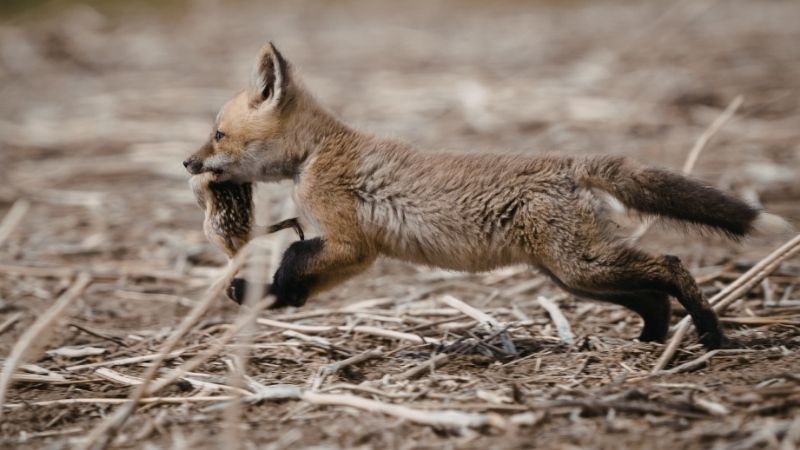
How much do you know about your dog’s natural prey drive? This instinct—inherited from their wolf ancestors and driving them to search for, chase, and capture prey—once ensured their survival in the wild. Today, should we seek to tame this instinct?
In this guide, we’ll define prey drive, explore which breeds exhibit it most strongly and why, learn how to recognize it in your own dog, and share effective strategies to help you channel this drive into positive activities.
What Is Prey Drive in Dogs?
Prey drive is a dog’s innate motivation to detect, pursue, and capture potential prey. It comprises a series of behavioral stages—often called the predatory sequence:
- Search: Scanning visually or sniffing the air for movement
- Stalk: Quietly approaching once a moving object is detected
- Chase: Pursuing the target at full speed
- Grab/Bite: Seizing or pinching the object
- Kill: Delivering a final bite
- Consume: Eating the prey
In modern canine companions, most of the sequence ends after the chase or grab stages. Recognizing these phases helps explain why your dog bolts at a bike or lunges at a fluttering leaf.
Which Breeds Have a High Prey Drive?
While individual variation always exists, certain breed groups tend to exhibit stronger prey drive. Here’s a quick overview:
|
Breed Group
|
Examples
|
Typical Prey Behavior
|
|---|---|---|
|
Sighthounds
|
Greyhound, Whippet, Saluki
|
Chase fast-moving targets purely by sight
|
|
Terriers
|
Jack Russell, Cairn Terrier, Fox Terrier
|
Fearless pursuit of small vermin
|
|
Herding Dogs
|
Border Collie, Australian Shepherd
|
Stalk-and-chase sequence directed at stock
|
|
Hounds
|
Beagle, Bloodhound
|
Scent tracking may switch to visual chase
|
|
Sporting Dogs
|
Labrador Retriever, Spaniel breeds
|
Flush and retrieve game, will pursue birds
|
Notably, mixed-breed dogs can inherit high prey drives from either parent. Always assess your individual dog rather than relying solely on breed stereotypes.
Why Do Some Dogs Have a Strong Prey Drive?
Several factors influence the intensity of a dog’s prey drive:
- Genetics
Dogs bred for hunting, vermin control, or herding often carry stronger chase instincts. Centuries of selective breeding emphasized speed, endurance, and sharp eyesight in certain lines. - Early Exposure
Puppies exposed to varied sights, sounds, and small animals learn to regulate chase impulses. Without proper exposure, even mild prey drive can escalate into uncontrollable chasing. - Individual Temperament
Just as humans vary in energy and focus, dogs differ in instinct strength. Within the same litter, one puppy might calmly observe a squirrel while its sibling rockets after it. - Environmental Reinforcement
If a quick chase ends in excitement—your cheers, laughter, or the thrill of the chase—the behavior becomes self-rewarding. Over time, dogs learn “chase = fun,” reinforcing the drive.
Understanding these influences empowers you to tailor management strategies to your dog’s unique profile.
Signs That Your Dog Has a Strong Prey Drive
Even well-trained dogs can exhibit intense chase instincts. Watch for these common signs:
- Locked-on Focus
Your dog watches moving objects—bikes, joggers, cats—with single-minded intensity, often ignoring commands. - Stiff Body Language
A rigid stance, crouched posture, raised hackles, and a fixed stare signal readiness to pounce. - High Arousal & Vocalization
Excited barking, whining, or growling whenever movement appears in the distance. - Difficulty Redirecting Attention
Even high-value treats or favorite toys fail to break fixation once the chase instinct activates. - Repeated Chasing Episodes
Recurring charges after wildlife, pets, or inanimate objects during walks or backyard play.
Recognizing these behaviors early allows you to implement appropriate redirection before the chase escalates.
How to Manage Your Dog’s Predatory Behavior
Effective prey-drive management blends redirection, self-control training, desensitization, adequate exercise, and reliable recall. Below are five key strategies:
1. Redirect the Instinct
It’s crucial to understand that prey drive is not aggression, but a natural behavior. Instead of trying to eliminate it, channel it into appropriate activities.
- Flirt Poles: A long pole with a dangling lure lets your dog run and pounce without endangering wildlife.
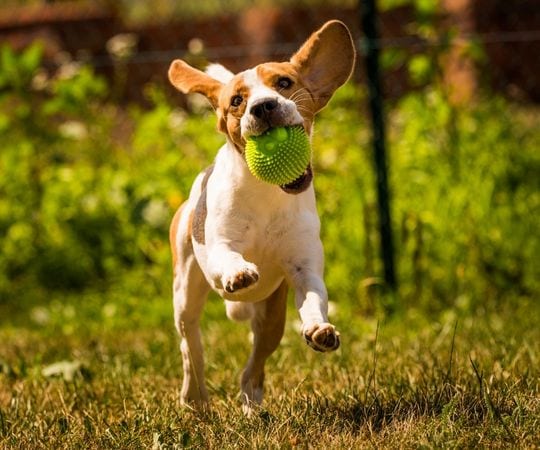
- Fetch Variations: Use balls, dummies, or frisbees to satisfy chase and retrieval instincts.

- Scent Games: Hide treats or toy parts around the yard or house to engage search and capture phases.
Redirecting this instinct keeps your dog mentally satisfied and reduces unwanted chasing.
2. Impulse-Control Exercises
Training your dog in basic obedience is non-negotiable. Impulse control is the mental muscle that allows your dog to pause.
Teach skills like “sit-stay,” “wait,” and “go find it.” Start in a low-distraction environment, rewarding calm behavior before allowing movement. Gradually increase distractions—first adding distance, then outdoor noises or other dogs—to build self-control even when something triggers their chase instinct.
3. Desensitization Training
Use a long line (5–10 m) to manage distance from triggers:
- Identify a stimulus distance where your dog notices but doesn’t react.
- Reward focused attention and relaxed breathing with high-value treats.
- Gradually decrease the distance over multiple short sessions, reinforcing calm behavior.
4. Physical & Mental Exercises
A well-exercised dog is less likely to hyper-focus on prey:
- Daily Cardio: Brisk walks, jogs, or off-leash play in secure areas.
- Interactive Toys: Puzzle feeders, treat-dispensing balls, and snuffle mats challenge the mind.

- Training Games: Teach new tricks, engage in agility drills, or explore nose-work classes.
5. An Emergency Recall
A strong come-when-called can stop a chase in its tracks. Train recall with positive reinforcement—use treats, praise, or play as rewards. Introduce an emergency recall word (e.g., “Now!”) paired with an ultra-high-value reward reserved exclusively for urgent situations.
FAQs
Can I completely eliminate prey drive?
No. Prey drive is a hard-wired, evolutionary instinct. You can’t remove it—but you can teach your dog to control impulses and channel the drive into safe, enjoyable activities.
At what age should I start management training?
Begin impulse-control games and exposure work as early as 8–10 weeks, alongside basic socialization. Early training sets the foundation for lifelong self-control.
Is a strong prey drive a bad thing?
Not inherently. A pronounced drive can fuel sports like lure coursing, agility, and scent work. Problems arise only when the behavior becomes unmanageable or unsafe.
My dog fixes on squirrels even with distractions. What else can I try?
Increase distance from the trigger, reinforce calm behavior with premium treats, and consult a professional dog trainer or behaviorist for personalized strategies.
Are aversive tools (e.g., shock collars) effective?
Aversive methods often increase anxiety, worsen chase behavior, and damage trust. Positive-reinforcement techniques yield safer, more reliable, and long-lasting results.
Conclusion
Prey drive is a legacy of canine survival instincts that still persists in our pet dogs today. While you cannot eliminate this instinct, you can manage it actively through thoughtful redirection, structured impulse-control exercises, gradual desensitization, robust physical and mental exercises, and a reliable emergency recall. With patience and consistency, you can keep your dog’s impulsive chasing behavior within healthy, constructive bounds.

 EN
EN  AR
AR  DE
DE  ES
ES  NL
NL  FR
FR  TR
TR  PL
PL  SV
SV  EL
EL  IT
IT